
Lights flickering
Tell whether one bulb, one room or the whole house is flickering, which shows if it’s a simple fix or a call to the utility or an electrician.
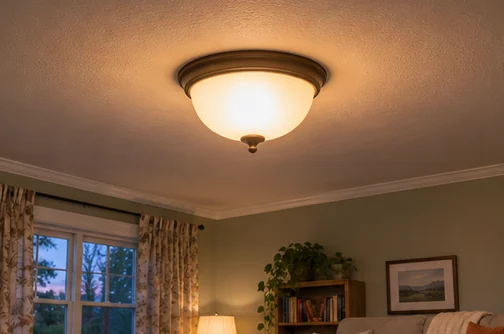
Short answer: A single flickering light is often a loose bulb or an LED bulb that doesn’t match its dimmer. Tighten the bulb, check the bulb and dimmer labels, and notice whether flicker starts when big appliances turn on. If the whole house flickers, call your utility; for anything else a new bulb doesn’t fix, call a licensed electrician.
Check the warning signs below first.
Use this guide at your own risk. It’s general information, not professional advice. By using it, you agree to our Terms of Use and Safety Waiver.
Check for danger first
If any of these are present, stop here.
- Gas odor, smoke or fire. Leave immediately. From outside, call emergency services. For a gas odor, also call the gas utility. Leave lights and switches alone.
- Burning smell, scorch marks, a hot outlet or a buzzing panel. Stop and call an electrician. Stay clear of a suspect panel.
- Water near electrical equipment or exposed wiring. Keep away. Never cross water to reach a plug or breaker. Call a qualified electrician.
None of these warning signs? Open the checks
What to check
Have ready. A flashlight, a spare bulb you know works, and the box or label of your LED bulbs and your dimmer.
See how far it goes.
Note whether one bulb, one room or every room flickers, and whether it starts when something big turns on. Ask a neighbor if their lights flicker too.
Tighten the bulb.
Turn the light off and let the bulb cool. Then turn the bulb gently until it’s snug. A loose bulb is one of the simplest causes of flicker.
Check that the bulb and dimmer match.
LED bulbs on a dimmer flicker when the two don’t match. The bulb must say dimmable, and the dimmer must be rated for LED. Try a bulb the dimmer’s maker lists as compatible. Replacing the dimmer itself is wiring work for an electrician.
Watch the big appliances.
Appliances that heat or cool draw a lot of power. If lights flicker or dim when one of them turns on, move other high-power devices off that circuit and have an electrician check the wiring.
When to stop. If lights flicker all over the house, or your neighbors’ do too, call your utility to report it. If a new bulb doesn’t fix it, or the flicker comes with buzzing, a burning smell or a warm switch, stop and call a licensed electrician. Loose wiring is not a DIY repair.
What it costs
- The checks above: free.
- Electrician service call: $176–$327.
- Most electricians charge $40–$120 an hour. Installing a light switch runs $85–$200.
National US ranges from 2025–2026 cost guides: Fixr · This Old House. Prices in your area may differ.
Common causes
- Loose bulb. A bulb that isn’t screwed in snugly loses contact and flickers. You can check
- LED bulb and dimmer don’t match. LED flicker on a dimmer is almost always a mismatch between the bulb and the dimmer, or a bulb that isn’t dimmable. You can check
- Dimmer not rated for LED. Dimmers made only for incandescent or halogen bulbs can flicker, buzz or cut out with LEDs, and replacing one is wiring work. Call a pro
- Big appliance on the same circuit. Appliances that heat or cool draw a lot of power and can dim lights on the same circuit. Call a pro
- Loose wiring connection. Loose connections in your home’s wiring can make lights flicker and need a licensed electrician. Call a pro
- Voltage changes from the utility. Flicker across the whole home, or at neighbors’ homes too, points to the utility supply. Call a pro
Sources: This Old House · Feit Electric · UL.
Further reading · This Old House
Still stuck? Get help with your exact problem.
Snap a photo and tell the app what you’ve tried. It walks you through your model, one safe step at a time, and tells you when to call a pro. Your first fix in the app is free.
The app is coming soon. Get one email the day it launches.
One email when the app launches. No spam. Privacy Policy