
Recessed light turns off by itself
Tell whether a recessed light that cycles off and on is overheating from the bulb, from something around the housing, or from a fault.
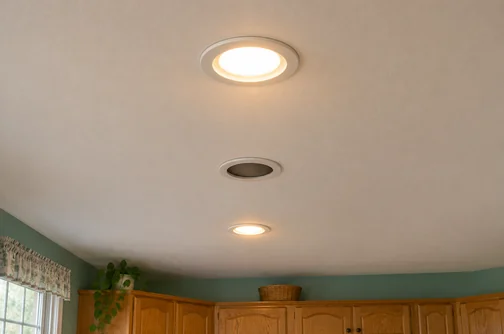
Short answer: A recessed light that shuts off and comes back on is usually overheating, and its built-in heat switch is cutting the power. Check that the bulb is within the wattage on the label inside the can and move stored items off the housing. If it keeps cycling, a licensed electrician needs to check the insulation, trim and heat switch.
Check the warning signs below first.
Use this guide at your own risk. It’s general information, not professional advice. By using it, you agree to our Terms of Use and Safety Waiver.
Check for danger first
If any of these are present, stop here.
- Gas odor, smoke or fire. Leave immediately. From outside, call emergency services. For a gas odor, also call the gas utility. Leave lights and switches alone.
- Burning smell, scorch marks, a hot outlet or a buzzing panel. Stop and call an electrician. Stay clear of a suspect panel.
- Water near electrical equipment or exposed wiring. Keep away. Never cross water to reach a plug or breaker. Call a qualified electrician.
None of these warning signs? Open the checks
What to check
Have ready. A flashlight, a stepladder, the wattage printed on the bulb and a way to see the attic above the light, if there is one.
Watch the pattern.
If the light goes out after it has been on a while, stays off for a few minutes, then comes back on, a heat switch in the fixture is likely shutting it off because it is too hot. Treat that as a warning, not a nuisance.
Check the bulb wattage.
Turn the light off and let the bulb cool. Remove the bulb and look inside the can for the label that gives the maximum wattage. If your bulb is higher, replace it with a lower-wattage bulb, such as an LED of the same size, that is within the label limit.
Look for things piled on the housing.
If the light is under an attic you can see into from the hatch, look without crawling over the fixture. Boxes, clothing or other stored items against the housing trap heat, so move them away. Leave insulation and any insect nests for a pro.
When to stop. If it still cycles with the right bulb, or you see insulation packed against the housing, scorch marks or melted parts, or smell burning, turn it off and call a licensed electrician. Replacing a heat switch or trim, or fixing insulation clearance, means opening the housing.
What it costs
- The checks above: free.
- Electrician service visit: about $176–$327.
- Recessed light installed: about $175–$225 per light.
National US ranges from 2025–2026 cost guides: Fixr · Thumbtack · Fixr recessed lighting. Prices in your area may differ.
Common causes
- Bulb wattage too high. A bulb above the fixture’s marked wattage makes more heat than the housing is built for. You can check
- Stored items against the housing. Boxes, clothing or other things touching the can in an attic act like extra insulation and trap heat. You can check
- Insulation on a housing not rated for it. Housings not marked IC need clearance from insulation, and covering them makes them overheat. Call a pro
- Wrong trim for the housing. A trim not approved for that housing can trap heat and trip the heat switch. Call a pro
- Worn heat switch. A heat switch that is failing can shut the light off even when the fixture isn’t very hot. Call a pro
Sources: IAEI Magazine · Ask the Builder.
Further reading · IAEI Magazine
Still stuck? Get help with your exact problem.
Snap a photo and tell the app what you’ve tried. It walks you through your model, one safe step at a time, and tells you when to call a pro. Your first fix in the app is free.
The app is coming soon. Get one email the day it launches.
One email when the app launches. No spam. Privacy Policy