
Dimmer switch not working or buzzing
Tell whether the bulbs, a setting or the load is the problem, or the dimmer itself needs an electrician.
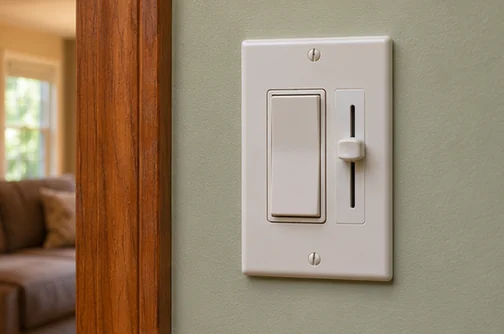
Short answer: It’s usually the bulbs: LEDs that aren’t dimmable or don’t match the dimmer, or a low-end setting that’s too low. Check the bulbs, try a compatible one, adjust the low end and keep the watts under the limit. A warm plate is normal; a hot, noisy or burnt-smelling dimmer is a job for an electrician.
Check the warning signs below first.
Use this guide at your own risk. It’s general information, not professional advice. By using it, you agree to our Terms of Use and Safety Waiver.
Check for danger first
If any of these are present, stop here.
- Gas odor, smoke or fire. Leave immediately. From outside, call emergency services. For a gas odor, also call the gas utility. Leave lights and switches alone.
- Burning smell, scorch marks, a hot outlet or a buzzing panel. Stop and call an electrician. Stay clear of a suspect panel.
- Water near electrical equipment or exposed wiring. Keep away. Never cross water to reach a plug or breaker. Call a qualified electrician.
None of these warning signs? Open the checks
What to check
Have ready. A flashlight, the bulb boxes or the wattage printed on the bulbs, and the dimmer’s brand and model.
Check the bulbs.
Make sure every bulb on the dimmer is marked dimmable; many LEDs aren’t. Replace any burned-out bulb. If only one light is on the dimmer and it fails, the dimmer won’t work.
Use bulbs that match the dimmer.
LED bulbs behave differently on dimmers. Look up your dimmer and bulb in the maker’s compatibility tool, and try a different bulb if it buzzes or flickers. Some dimmers need at least one bulb from their approved list to work right.
Adjust the low end.
If the lights buzz or flicker only when dimmed low, raise the dimmer’s low-end trim as its instructions show, or don’t dim as low.
Feel the wall plate.
A dimmer’s plate can feel quite warm when the lights are on, and that’s normal. It should never be hot, noisy or smell burnt. Add up the bulb watts and keep them under the limit printed on the dimmer.
When to stop. If the dimmer is too hot to keep your hand on, smells burnt, is discolored, stays warm with the lights off, or buzzes loudly with any bulb, turn off its breaker and call a licensed electrician. Replacing a dimmer means working on the wiring.
What it costs
- The checks above: free.
- Electrician to install a dimmer: about $75–$100, including a $10–$25 dimmer.
- Light switch installation: $85–$200.
National US ranges from 2025–2026 cost guides: Fixr · This Old House. Prices in your area may differ.
Common causes
- Bulbs that aren’t dimmable. Many LEDs, including some smart bulbs, aren’t made to dim and will flicker or drop out. You can check
- Bulb and dimmer don’t match. Some LEDs hum more than others on the same dimmer, so a different bulb often stops the buzz. You can check
- Low-end setting too low. An LED may not dim as low as the dimmer, so it flickers or buzzes at the bottom of the range. You can check
- Too many watts on the dimmer. Each dimmer has a load limit, and going over it makes it run hot. You can check
- Loose wiring or a worn dimmer. Loose wires or poor connections create resistance and heat, and the dimmer may need replacing. Call a pro
Sources: Lutron · Lutron dimmer heat · Mr. Electric.
Further reading · Lutron
Still stuck? Get help with your exact problem.
Snap a photo and tell the app what you’ve tried. It walks you through your model, one safe step at a time, and tells you when to call a pro. Your first fix in the app is free.
The app is coming soon. Get one email the day it launches.
One email when the app launches. No spam. Privacy Policy