
AC leaking water
Find out whether a clogged drain line, a full drain pan or a frozen coil is putting water on the floor.
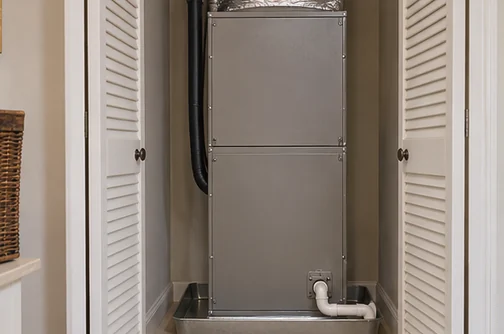
Short answer: Most indoor leaks come from a clogged condensate drain line or a frozen coil caused by a dirty filter. Turn the system off, replace a dirty filter, look for ice, and clear the drain line only if your manual says to. If it still leaks or the coil is frozen, call an HVAC technician.
Check the warning signs below first.
Use this guide at your own risk. It’s general information, not professional advice. By using it, you agree to our Terms of Use and Safety Waiver.
Check for danger first
If any of these are present, stop here.
- Gas odor, smoke or fire. Leave immediately. From outside, call emergency services. For a gas odor, also call the gas utility. Leave lights and switches alone.
- Burning smell, scorch marks, a hot outlet or a buzzing panel. Stop and call an electrician. Stay clear of a suspect panel.
- Water near electrical equipment or exposed wiring. Keep away. Never cross water to reach a plug or breaker. Call a qualified electrician.
None of these warning signs? Open the checks
What to check
Have ready. Towels, a new air filter in the right size, a flashlight and your system’s owner’s manual. A wet-dry vacuum if your manual calls for one.
Turn the system off.
Set the thermostat to Off so no more water collects. Carrier and Trane both advise not running the AC while it leaks. Wipe up the water you can reach safely.
Check the air filter.
A dirty filter blocks airflow and can freeze the indoor coil. When the ice melts, the water can overflow the drain pan. Replace it if it’s dirty; Carrier and Trane advise every 1 to 3 months.
Look for ice.
If you see frost or ice on the indoor unit or its pipes, leave the system off so it can thaw. A frozen coil needs an HVAC technician to find out why it froze.
Clear the drain line only if your manual says to.
A clogged condensate drain line is a common cause, and many systems have an overflow switch that shuts the AC off when the pan fills. Carrier’s method is a wet-dry vacuum on the outdoor end of the drain line with the AC off. Don’t do it if you aren’t sure which pipe is the drain line.
When to stop. If it still leaks, the coil is frozen, the drain pan is cracked or rusted, or the system won’t restart, stop and call an HVAC technician. Drain pans, pumps, overflow switches and refrigerant are pro work.
What it costs
- The checks above: free.
- Pro to clear a clogged condensate line: $75–$250.
- Bigger fixes: a condensate pump, $100–$500; a new drain pan, $200–$600.
- Most AC repairs: $205–$907.
National US ranges from 2025–2026 cost guides: Fixr · Thumbtack. Prices in your area may differ.
Common causes
- Clogged condensate drain line. Dust, algae and mold build up in the line, and the water backs up into the house instead of draining outside. You can check
- Dirty air filter. Restricted airflow freezes the indoor coil, and the melting ice overflows the drain pan. You can check
- Cracked or rusted drain pan. A damaged pan can’t hold and channel the water away from the unit. Call a pro
- Overflow switch tripped. When water in the pan reaches a set level, this switch shuts the system down, and a technician checks the line and pan. Call a pro
- Low refrigerant. Low refrigerant can freeze the coil, and refrigerant work needs a licensed technician. Call a pro
Sources: Carrier · Trane · Trane overflow switch.
Further reading · Carrier
Still stuck? Get help with your exact problem.
Snap a photo and tell the app what you’ve tried. It walks you through your model, one safe step at a time, and tells you when to call a pro. Your first fix in the app is free.
The app is coming soon. Get one email the day it launches.
One email when the app launches. No spam. Privacy Policy