
Furnace leaking water
Find where the water comes from, check the filter and the parts you can see, and know when to call an HVAC technician.
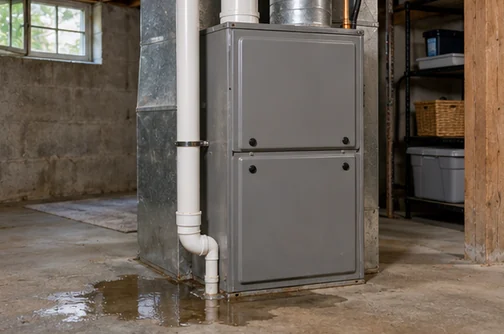
Short answer: Most furnace leaks come from a high-efficiency furnace’s clogged condensate drain, a failed condensate pump, a humidifier, or the AC coil drain in summer. Turn the system off, mop up, rule out nearby leaks, check the filter and look at the pump and humidifier without opening the furnace. If water keeps coming, call an HVAC technician.
Check the warning signs below first.
Use this guide at your own risk. It’s general information, not professional advice. By using it, you agree to our Terms of Use and Safety Waiver.
Check for danger first
If any of these are present, stop here.
- Gas odor, smoke or fire. Leave immediately. From outside, call emergency services. For a gas odor, also call the gas utility. Leave lights and switches alone.
- Burning smell, scorch marks, a hot outlet or a buzzing panel. Stop and call an electrician. Stay clear of a suspect panel.
- Water near electrical equipment or exposed wiring. Keep away. Never cross water to reach a plug or breaker. Call a qualified electrician.
None of these warning signs? Open the checks
What to check
Have ready. Towels or a mop, a bucket, a flashlight and a new air filter in the right size.
Turn the system off and clean up.
Turn the furnace off at the thermostat or its breaker so water can’t reach electrical parts. Mop up the water and dry the area, because standing water can lead to mold.
Make sure it’s the furnace.
Look at what’s nearby. A water heater, washing machine, laundry sink or pipe can leak and look like a furnace leak. In summer, the water may come from the AC coil drain pan above the furnace.
Check the air filter.
Pull out the filter. If it’s dirty or wet, replace it. A clogged filter can make the AC coil freeze and drip when it melts.
Look at the drain parts you can see.
High-efficiency furnaces make water and send it through a drain line, sometimes to a small plug-in condensate pump. If that pump’s tank is full and it isn’t pumping, or a humidifier on the ductwork is dripping, that’s likely the source. Don’t open the furnace.
When to stop. If the water keeps coming, or you see a clogged drain line, a failed pump or a leaking humidifier, call an HVAC technician. Leave gas parts, the burners and the heat exchanger to the pro. If your CO alarm goes off, get everyone outside and call 911.
What it costs
- The checks above: free.
- Pro furnace repair: $349–$650, about $485 on average; many pay around $352.
- Common fix: clearing a clogged condensate drain line, $75–$250.
National US ranges from 2025–2026 cost guides: Fixr · Thumbtack · Fixr drain line. Prices in your area may differ.
Common causes
- Clogged condensate drain line or trap. High-efficiency furnaces make water, and dirt in the drain line or trap backs it up onto the floor. Call a pro
- Failed condensate pump. A pump that stops working lets its tank overflow; Lennox says they typically last three to five years. Call a pro
- AC coil drain pan overflowing. In summer, a clogged drain pan under the AC coil above the furnace can spill water. Call a pro
- Dirty air filter. Low airflow can freeze the AC coil, and the melting ice drips under the unit. You can check
- Leaking humidifier. A whole-house humidifier with a clogged pad, cracked drain line or loose connection can leak into the furnace. Call a pro
- Cracked heat exchanger or flue problem. Less common but serious, because a crack can let combustion gases, including carbon monoxide, into the air. Call a pro
Further reading · Carrier
Still stuck? Get help with your exact problem.
Snap a photo and tell the app what you’ve tried. It walks you through your model, one safe step at a time, and tells you when to call a pro. Your first fix in the app is free.
The app is coming soon. Get one email the day it launches.
One email when the app launches. No spam. Privacy Policy