
Dishwasher leaving white residue
Tell hard-water film from permanent etching, then fix the water temperature, rinse aid and detergent amount and clean the film off.
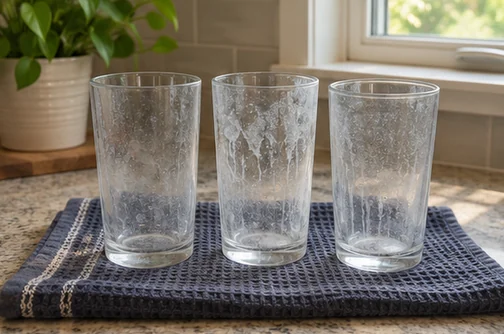
Short answer: White residue is usually mineral film from hard water, made worse by an empty rinse aid dispenser, the wrong amount of detergent or water that isn’t hot enough. Do the vinegar test, run the sink hot first, fill the rinse aid, set the detergent and clean the film with citric acid. If it comes right back, call a pro.
Check the warning signs below first.
Use this guide at your own risk. It’s general information, not professional advice. By using it, you agree to our Terms of Use and Safety Waiver.
Check for danger first
If any of these are present, stop here.
- Gas odor, smoke or fire. Leave immediately. From outside, call emergency services. For a gas odor, also call the gas utility. Leave lights and switches alone.
- Burning smell, scorch marks, a hot outlet or a buzzing panel. Stop and call an electrician. Stay clear of a suspect panel.
- Water near electrical equipment or exposed wiring. Keep away. Never cross water to reach a plug or breaker. Call a qualified electrician.
None of these warning signs? Open the checks
What to check
Have ready. White vinegar, a food thermometer and a glass, rinse aid, and citric acid or a dishwasher cleaner.
Do the vinegar test.
Rub a cloudy glass with a little white vinegar. If the white comes off, it’s film from hard water or detergent. If it doesn’t, it may be etching, which Whirlpool says is permanent damage to the glass.
Start with hot water.
GE says the water entering the dishwasher should be at least 120°F. Run the hot water at the kitchen sink before you start a cycle. If a food thermometer in that water reads under 120°F, have the water heater checked.
Fill the rinse aid and set the detergent right.
An empty rinse aid dispenser causes spots, so keep it full. Use the amount your water needs: soft water needs less detergent, very hard water needs more. Too much detergent can etch glass.
Clean off the film.
Load only the filmed glasses and dishes, with no silverware or metal. Put citric acid in the detergent cup and run a full cycle with no detergent, as GE directs, or use a dishwasher cleaner such as affresh, following its label.
When to stop. Stop and call a pro if the film comes right back after these steps, the dishwasher doesn’t get hot, or it doesn’t fill or drain right. If your water is 15 grains per gallon or harder, Whirlpool strongly recommends a water softener, which a plumber installs. Etched glass can’t be fixed.
What it costs
- The checks above: free.
- Dishwasher repair: $117–$300, most pay about $187.
- Water softener installed: $1,100–$3,000, about $2,500 on average.
National US ranges from 2025–2026 cost guides: Thumbtack · Fixr. Prices in your area may differ.
Common causes
- Hard water minerals. White film is most common in hard water areas, where mineral buildup forms on glasses and dishes. You can check
- Empty rinse aid dispenser. Rinse aid helps water sheet off dishes; without it, spots form. You can check
- Wrong amount of detergent. Soft water needs less detergent and very hard water needs more; too much can etch glass. You can check
- Water not hot enough. Water under 120°F may not dissolve the detergent, leaving grit and residue. You can check
- Very hard water needing a softener. At 15 grains per gallon or more, Whirlpool strongly recommends a water softener. Call a pro
- Etching. Etching is wear on the glass surface from the dishwasher’s heat and chemistry, and it can’t be reversed. Call a pro
Sources: GE Appliances · GE white film · Whirlpool etching · Whirlpool film · Cascade.
Further reading · GE Appliances
Still stuck? Get help with your exact problem.
Snap a photo and tell the app what you’ve tried. It walks you through your model, one safe step at a time, and tells you when to call a pro. Your first fix in the app is free.
The app is coming soon. Get one email the day it launches.
One email when the app launches. No spam. Privacy Policy