
Water heater leaking
Find where the water comes from, shut off the energy and the cold water, and know when the tank needs replacing.
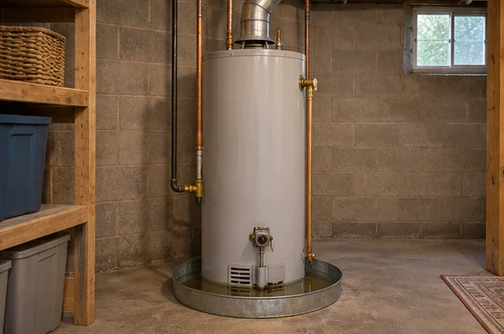
Short answer: Find where the water comes from, turn off the breaker or set the gas control to OFF or PILOT per the label, and shut the cold water valve. A leak from the base of the tank usually means the heater needs replacing. Leaks from the tank, relief valve, drain valve or gas area are jobs for a licensed plumber.
Check the warning signs below first.
Use this guide at your own risk. It’s general information, not professional advice. By using it, you agree to our Terms of Use and Safety Waiver.
Check for danger first
If any of these are present, stop here.
- Gas odor, smoke or fire. Leave immediately. From outside, call emergency services. For a gas odor, also call the gas utility. Leave lights and switches alone.
- Burning smell, scorch marks, a hot outlet or a buzzing panel. Stop and call an electrician. Stay clear of a suspect panel.
- Water near electrical equipment or exposed wiring. Keep away. Never cross water to reach a plug or breaker. Call a qualified electrician.
None of these warning signs? Open the checks
What to check
Have ready. A flashlight, dry towels, a bucket and the label on the side of the water heater.
Find where the water is coming from.
Wipe the heater and floor dry and watch where new water shows up: the pipe fittings on top, the relief valve or its discharge pipe on the side, the drain valve near the bottom, or the base of the tank. Damp spots that don’t come back may just be condensation.
Turn off the power or the gas.
Electric heater: switch off its breaker. Gas heater: turn the control knob to OFF or PILOT, as the label on the heater shows. If you smell gas, leave the house and call the gas company from outside.
Shut off the cold water.
Turn the valve on the cold water pipe going into the top of the tank clockwise until it stops. If there isn’t one, use the main water shut-off for the house.
Read what you found.
Water from the base of the tank usually means the tank has corroded through, and a corroded tank can’t be repaired. Water from the relief valve or its discharge pipe means the pressure or temperature is too high or the valve has failed.
When to stop. Leave the energy and water off and call a licensed plumber for any leak from the tank, the relief valve or its pipe, the drain valve, or near the gas burner or gas line. Don’t try to replace the relief valve yourself.
What it costs
- The checks above: free.
- Pro water heater repair: $150–$750, about $450 on average.
- Common fix: a new pressure relief valve, $100–$250.
- Leaking tank: a new water heater, $600–$2,000.
National US ranges from 2025–2026 cost guides: Fixr · This Old House. Prices in your area may differ.
Common causes
- Condensation, not a leak. Moisture can form on the outside of the tank, and if a dried spot doesn’t come back within a few hours it isn’t a leak. You can check
- Loose pipe fittings on top. The cold inlet and hot outlet connections can work loose and drip down the tank. Call a pro
- The relief valve releasing water. The temperature and pressure relief valve lets water out when pressure or temperature gets too high, or drips when it has failed. Call a pro
- A worn drain valve. A drain valve near the bottom that won’t close fully usually needs to be replaced. Call a pro
- A corroded tank. Water from the base usually means rust has eaten through the steel tank, and the heater must be replaced. Call a pro
Sources: A. O. Smith · A. O. Smith leak steps · Lennox.
Further reading · A. O. Smith
Still stuck? Get help with your exact problem.
Snap a photo and tell the app what you’ve tried. It walks you through your model, one safe step at a time, and tells you when to call a pro. Your first fix in the app is free.
The app is coming soon. Get one email the day it launches.
One email when the app launches. No spam. Privacy Policy