
Water heater relief valve leaking
Tell a drip from thermal expansion or high water pressure apart from a valve or heater that needs a plumber, without ever plugging the valve.
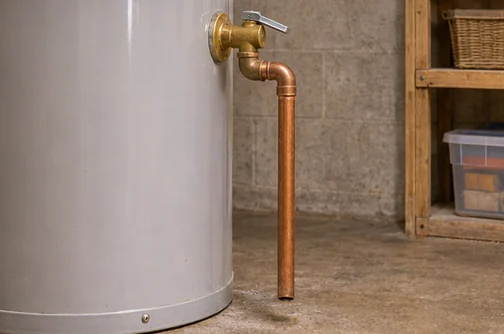
Short answer: A drip during heating usually means thermal expansion or water pressure above 80 psi, while a steady flow or a gush of hot water points to overheating or a failing valve. Never plug it: note when it drips and check your water pressure. A licensed plumber should add a pressure reducing valve or expansion tank, or replace the valve.
Check the warning signs below first.
Use this guide at your own risk. It’s general information, not professional advice. By using it, you agree to our Terms of Use and Safety Waiver.
Check for danger first
If any of these are present, stop here.
- Gas odor, smoke or fire. Leave immediately. From outside, call emergency services. For a gas odor, also call the gas utility. Leave lights and switches alone.
- Burning smell, scorch marks, a hot outlet or a buzzing panel. Stop and call an electrician. Stay clear of a suspect panel.
- Water near electrical equipment or exposed wiring. Keep away. Never cross water to reach a plug or breaker. Call a qualified electrician.
None of these warning signs? Open the checks
What to check
Have ready. A flashlight, a bucket, a water pressure gauge that screws onto an outdoor faucet, and the water heater’s brand and age.
Never plug or cap it.
The relief valve is a safety device that keeps the tank from bursting. Make sure its discharge pipe is open and runs down toward the floor or a drain. Keep your hands and face away from the end, because the water can be very hot.
Note when it drips.
A small release during or right after heating is a common sign of thermal expansion. Rheem says about a cup for every 10 gallons of tank size each heating cycle. A steady flow when the heater isn’t heating, or a large gush of hot water, is not normal.
Check your water pressure.
Screw a pressure gauge onto an outdoor faucet and open the faucet. Check at night too, when pressure runs higher. A. O. Smith says above 80 psi is over the code maximum and a pressure reducing valve should be installed.
Ask about an expansion tank.
A home with a check valve or pressure reducing valve is a closed system, so heated water has nowhere to go. Makers recommend an expansion tank on the cold water line. A. O. Smith says to control the pressure and add the tank before replacing a dripping valve.
When to stop. If it flows steadily, lets out a large gush of hot water, or sprays steam, keep everyone away from the heater and call a licensed plumber right away. On an electric heater, switching its breaker off cuts the heat. Replacing the relief valve, a pressure reducing valve or an expansion tank is a job for a licensed plumber.
What it costs
- The checks above: free.
- Plumber to replace the relief valve: $100–$250, parts and labor.
- Plumbers charge about $40–$200 an hour.
National US ranges from 2025–2026 cost guides: Fixr · This Old House. Prices in your area may differ.
Common causes
- Thermal expansion. In a closed system, heated water has nowhere to go, so pressure builds and the valve weeps during heating. Call a pro
- Water pressure too high. Pressure above 80 psi is over the code maximum and often makes the valve drip; a plumber fixes it with a pressure reducing valve. You can check
- Overheating. A large, sporadic discharge of very hot water points to a malfunctioning thermostat. Call a pro
- Worn valve. Repeated discharges can wear the valve so it no longer seals. Call a pro
- Leak at the threads. Water at the valve’s threaded connection means it has to be removed and resealed. Call a pro
Sources: A. O. Smith · A. O. Smith checklist · Rheem · Watts.
Further reading · A. O. Smith
Still stuck? Get help with your exact problem.
Snap a photo and tell the app what you’ve tried. It walks you through your model, one safe step at a time, and tells you when to call a pro. Your first fix in the app is free.
The app is coming soon. Get one email the day it launches.
One email when the app launches. No spam. Privacy Policy