
Oven temperature wrong
Tell whether preheating, pans, foil, convection or the calibration setting is behind food that bakes too fast or too slow.
Short answer: Food that bakes too fast or too slow is often caused by a short preheat, dark pans, foil, crowded racks or lowering a convection setting twice. Preheat fully, check pans and foil, allow for convection, and test with a bake before using the oven’s temperature adjustment. If the bake element, door gasket or results still look wrong, call an appliance technician.
Check the warning signs below first.
Use this guide at your own risk. It’s general information, not professional advice. By using it, you agree to our Terms of Use and Safety Waiver.
Check for danger first
If any of these are present, stop here.
- Gas odor, smoke or fire. Leave immediately. From outside, call emergency services. For a gas odor, also call the gas utility. Leave lights and switches alone.
- Burning smell, scorch marks, a hot outlet or a buzzing panel. Stop and call an electrician. Stay clear of a suspect panel.
- Water near electrical equipment or exposed wiring. Keep away. Never cross water to reach a plug or breaker. Call a qualified electrician.
None of these warning signs? Open the checks
What to check
Have ready. The oven’s manual or model number, a can of refrigerated biscuits and your usual baking pans.
Let it preheat fully.
Wait for the preheat signal before you put food in, which takes about 12 to 15 minutes on many ovens. Keep the door closed; opening it often lets heat out and lengthens cooking time.
Check pans, racks and foil.
Leave about 2 inches around pans and the oven walls, and never cover a whole rack or the oven bottom with foil. With dark pans, lower the temperature 25°F. Make sure the racks are in the right way so the door closes and seals.
Know how convection changes the setting.
Many convection ovens lower the set temperature by 25°F on their own. Check your manual before you lower it again by hand, or food may cook too slowly.
Test with a bake, then adjust.
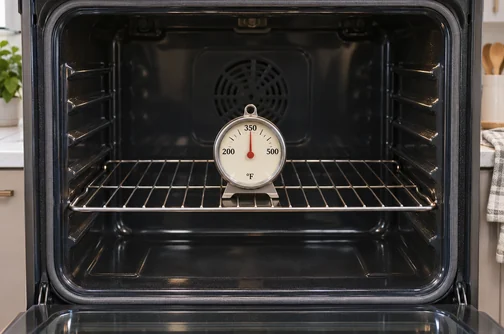
Ovens cycle about 30°F above and below the setting, so a cheap hanging thermometer can mislead you. Bake canned biscuits by the package directions instead. If food is still consistently off, use the temperature adjustment in your manual, in small steps, and test again.
When to stop. If the bake element on an electric oven doesn’t glow red, looks cracked or broken, the door gasket is torn, or food is still wrong after adjusting, stop and call an appliance repair technician. If a gas oven smells of gas, leave the house and call the gas utility from outside.
What it costs
- The checks above: free.
- Pro oven repair: $150–$400, about $200 on average.
- Common fixes: a new temperature sensor, $100–$250; a new door gasket, $100–$250.
- Service call fees are often about $75 and range from under $40 to over $200.
National US ranges from 2025–2026 cost guides: Fixr · This Old House. Prices in your area may differ.
Common causes
- Not fully preheated. Short bakes like biscuits and pies need the oven at full temperature from the start. You can check
- Pans, foil or rack placement. Dark pans, crowded racks and foil over a whole rack change how heat reaches the food. You can check
- Convection lowered twice. Many convection ovens already lower the setting by 25°F, so lowering it again undercooks food. You can check
- Calibration needs adjusting. Most ovens allow a small temperature offset within a limited range, set from the control as your manual explains. You can check
- Torn door gasket. A torn gasket lets heat escape and should be replaced by a technician. Call a pro
- Temperature sensor or bake element failing. A sensor whose calibration drifts, or a cracked bake element, keeps the oven from holding the right temperature. Call a pro
Sources: GE Appliances · Whirlpool · Fixr.
Further reading · GE Appliances
Still stuck? Get help with your exact problem.
Snap a photo and tell the app what you’ve tried. It walks you through your model, one safe step at a time, and tells you when to call a pro. Your first fix in the app is free.
The app is coming soon. Get one email the day it launches.
One email when the app launches. No spam. Privacy Policy