
Trash compactor not working
Check the drawer, the key switch, the power and the load before calling for service.
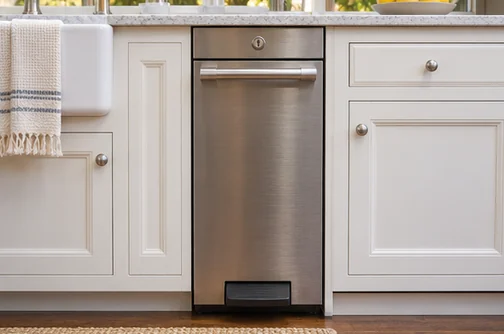
Short answer: A compactor that won’t run usually has a drawer that isn’t fully latched, a key not turned all the way, or no power at the outlet. Check those and don’t overload it. If it still won’t run or the ram is stuck, turn the key off and call an appliance technician.
Check the warning signs below first.
Use this guide at your own risk. It’s general information, not professional advice. By using it, you agree to our Terms of Use and Safety Waiver.
Check for danger first
If any of these are present, stop here.
- Gas odor, smoke or fire. Leave immediately. From outside, call emergency services. For a gas odor, also call the gas utility. Leave lights and switches alone.
- Burning smell, scorch marks, a hot outlet or a buzzing panel. Stop and call an electrician. Stay clear of a suspect panel.
- Water near electrical equipment or exposed wiring. Keep away. Never cross water to reach a plug or breaker. Call a qualified electrician.
None of these warning signs? Open the checks
What to check
Have ready. The compactor key, your owner’s manual and a flashlight.
Close the drawer firmly.
The compactor won’t run unless the drawer is fully closed and latched. Open it, make sure the bag and trash sit inside the container, then close it firmly and try again.
Use the key and start control the right way.
On key-knob models, turn the key fully to ON or START. Some models then need the foot start button pressed with your toe, and some need ON pressed before START or the switch held briefly. Your manual shows which.
Check the power.
Make sure the plug is firmly in a grounded outlet and the outlet isn’t controlled by a wall switch. Reset a tripped breaker or replace a blown fuse once.
Don’t overload it.
Don’t fill the bag with heavy material such as glass or push trash down with your hands or feet. If the ram is stuck down, turn the key to START, or press OFF then ON, to raise it. Never reach under the ram.
When to stop. If it hums but won’t move, the breaker trips again, or the ram stays stuck, turn the key off, remove it and call an appliance technician. Motor, switch and wiring repairs are for a pro.
What it costs
- The checks above: free.
- Appliance service call fees run from under $40 to over $200, most often about $75.
National US ranges from 2025–2026 cost guides: This Old House. Prices in your area may differ.
Common causes
- Drawer not fully closed. A safety switch stops the compactor unless the drawer is closed and latched. You can check
- Key or start control not used fully. The key must turn all the way, and some models also need the foot button or ON pressed first. You can check
- No power at the outlet. A loose plug, a wall-switched outlet, a tripped breaker or a blown fuse leaves it dead. You can check
- Overloaded bag. Heavy material such as glass, or trash pushed in by hand, can jam the ram or stop the cycle. You can check
- Failed switch or motor. A worn start, drawer or directional switch, or a motor that only hums, needs a technician. Call a pro
Sources: Whirlpool · KitchenAid · Whirlpool ram help · GE manual.
Further reading · Whirlpool
Still stuck? Get help with your exact problem.
Snap a photo and tell the app what you’ve tried. It walks you through your model, one safe step at a time, and tells you when to call a pro. Your first fix in the app is free.
The app is coming soon. Get one email the day it launches.
One email when the app launches. No spam. Privacy Policy