
Frozen pipes
Find the frozen spot, thaw it with gentle heat, and know when to shut off the water and call a plumber.
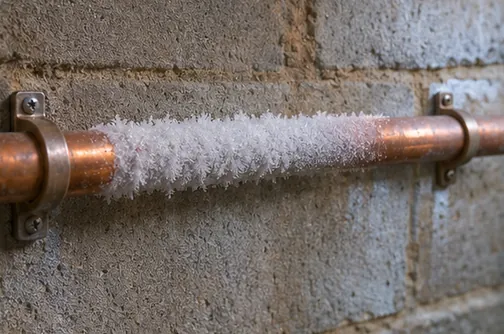
Short answer: A trickle from a faucet in cold weather usually means a pipe has frozen on an outside wall, in a cabinet or in an unheated space. Keep the faucet open and warm the pipe gently with a hair dryer, heating pad or hot towels, never an open flame. If it bursts, shut the main water valve and call a licensed plumber.
Check the warning signs below first.
Use this guide at your own risk. It’s general information, not professional advice. By using it, you agree to our Terms of Use and Safety Waiver.
Check for danger first
If any of these are present, stop here.
- Gas odor, smoke or fire. Leave immediately. From outside, call emergency services. For a gas odor, also call the gas utility. Leave lights and switches alone.
- Burning smell, scorch marks, a hot outlet or a buzzing panel. Stop and call an electrician. Stay clear of a suspect panel.
- Water near electrical equipment or exposed wiring. Keep away. Never cross water to reach a plug or breaker. Call a qualified electrician.
None of these warning signs? Open the checks
What to check
Have ready. A flashlight, an electric hair dryer or heating pad, towels, and the location of your main water shutoff valve.
Find the frozen section.
If you turn on a faucet and only a trickle comes out, suspect a frozen pipe. Look along exterior walls, in cabinets, and where the water line enters through the foundation. Check every faucet; if one pipe freezes, others may too.
Keep the faucet open.
Leave the faucet on as you work. As the ice melts, running water helps melt the rest.
Warm it gently, never with a flame.
Use an electric heating pad wrapped around the pipe, an electric hair dryer, a space heater kept away from anything that burns, or towels soaked in hot water. Never use a torch, propane or kerosene heater, or any open flame. Keep electric tools away from standing water. Keep going until full water pressure returns.
Prevent the next freeze.
In very cold weather, let cold water drip from faucets on exposed pipes, open sink cabinet doors, and keep the thermostat the same day and night. If you travel, leave the heat at 55°F or higher. Disconnect outdoor hoses.
When to stop. If a pipe has burst or leaks as it thaws, shut off the main water valve right away and call a licensed plumber. Also call one if you can’t find or reach the frozen section, or you can’t thaw it.
What it costs
- The checks above: free.
- Plumber to thaw an easy-to-reach pipe: $100–$200.
- Burst pipe repair: $234–$771 national average range.
National US ranges from 2025–2026 cost guides: Modernize · Thumbtack. Prices in your area may differ.
Common causes
- Pipes in an unheated space. Pipes in crawl spaces, attics, garages and sink cabinets freeze most often in a cold snap. You can check
- Pipes on an outside wall. Pipes that run along exterior walls with little or no insulation lose heat fast. You can check
- A hose left on an outdoor faucet. A connected hose traps water in the faucet, which can freeze and split the pipe. You can check
- Heat turned down at night or while away. Lower night or vacation settings let cold areas drop below freezing; keep it steady and at 55°F or higher when away. You can check
- A cracked or burst pipe. Ice expands and can split a pipe, and the leak often shows up only once it thaws. Call a pro
Sources: American Red Cross · Indiana Office of Utility Consumer Counselor · Woodford.
Further reading · American Red Cross
Still stuck? Get help with your exact problem.
Snap a photo and tell the app what you’ve tried. It walks you through your model, one safe step at a time, and tells you when to call a pro. Your first fix in the app is free.
The app is coming soon. Get one email the day it launches.
One email when the app launches. No spam. Privacy Policy